The year 2026 started with moderately positive signals for the Dutch market. The hospitality and hotel industry ended the fourth quarter of 2025 with a 3.2 percent increase. Retail trade recorded a turnover growth of 2.2 percent in January, and inflation stabilized at 2.4 percent in February. Despite these figures, business sentiment remains cautious. Data published by the Dutch statistics office CBS shows not only the current state of the economy, but also growing staffing challenges in key employment sectors.

Table of Contents

  1. Inflation Under Control – Stable Consumer Market
  2. Retail Trade Gains – Rising Demand for Personnel
  3. HoReCa Industry: Turnover Growth, Business Pessimism
  4. Staffing Challenges of the Dutch Labor Market
  5. How Intraservis Supports Dutch Employers
  6. Summary
  7. FAQ – Frequently Asked Questions

Inflation Under Control – Stable Consumer Market

The latest CBS data shows that inflation in the Netherlands was only 2.4 percent in February 2026. This is maintaining the same level as in the previous month, and the stabilization is very good news. Especially if we go back to 2022/2023, when inflation could reach even 14.5 percent. Returning to a level close to the European Central Bank’s target is a signal that price pressure on households has significantly decreased. This also means that the consumption possibilities of people living in the Netherlands have increased. This also applies to the condition of enterprises operating in sectors serving consumers.
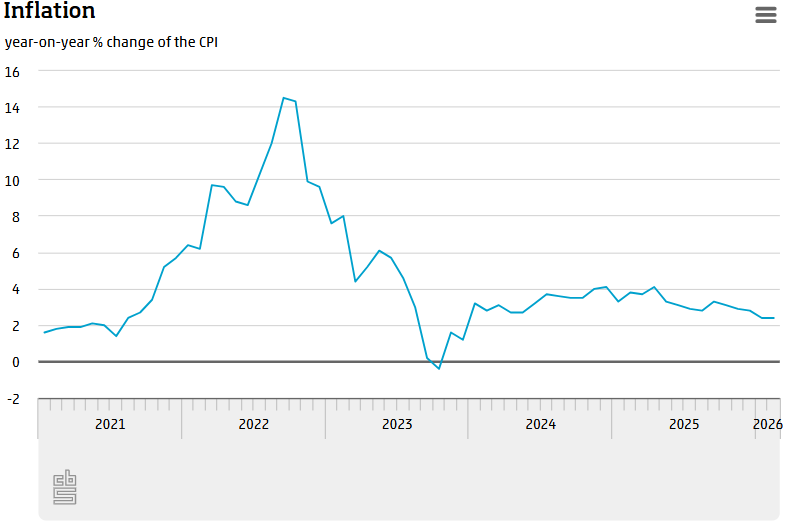
Detailed analysis shows varied pace of price growth in individual product categories. The highest price jump was recorded in services, which amounted to 4.2 percent year-on-year, while for food and beverage prices we’re talking about an increase of 1.4 percent. Particularly interesting are energy prices, including motor fuels. Compared to the previous year, they hardly changed at all, which is a huge difference considering the increases observed at the peak of the energy crisis.

IInflation stabilization is hugely important for the labor market, especially for sectors such as retail or hospitality. It is in these sectors that wages constitute a significant share of operating costs, and employers over recent years have had to raise salaries to keep up with rising living costs and maintain competitiveness in the fight for workers.

Retail Trade Gains – Rising Demand for Personnel

Turnover in Dutch retail trade increased by 2.2 percent in January 2026 compared to January of the previous year, with sales volume, adjusted for price changes, increasing by 1.2 percent. This growth, although moderate, shows that consumers in the Netherlands maintain a certain level of confidence in the economy and are willing to spend money despite earlier turbulence related to high inflation.

It’s worth noting that the food sector recorded a turnover increase of 2.6 percent, but supermarkets did better than specialist stores. Large chains increased their turnover by 3.2 percent, while smaller stores recorded a decline of 0.9 percent. This situation shows that consumers are still looking for savings, and due to economies of scale, prices in large-format stores are significantly lower.

In the non-food sector, sales at the level of 1.9 percent were recorded. The biggest increase was recorded by consumer electronics stores, as their turnover increased by as much as 10.8 percent. Good results were also recorded by personal care product stores (+8.9 percent) and footwear stores (+4.1 percent). Importantly, the fastest-growing segment of Dutch retail trade, namely online trade, also continued its upward trajectory. It increased its turnover by 3.6 percent in January 2026, with online sales of food and personal care products growing particularly dynamically, by as much as 7.0 percent.

How should the labor market read this data? It means growing demand not only for workers in traditional brick-and-mortar stores, where salespeople, cashiers and shift managers are needed, but also for staff in logistics centers and warehouses serving online trade, where manual workers are involved in order picking, product packaging and logistics system operation.

HoReCa Industry: Turnover Growth, Business Pessimism

The Dutch hospitality and hotel industry can also be pleased with growth. In its case, turnover increased by 3.2 percent compared to the same period last year. However, it should be noted that this result is the result of differentiated trends in individual segments of the industry.

Catering services did significantly better than the accommodation sector, recording a turnover increase of 4.2 percent, while in the case of the accommodation sector, this increase was only 0.5 percent. The highest growth in the catering segment was recorded by catering services and canteens (6.2 percent), which shows that both private companies and public institutions have returned to regular use of external catering services after the period of restrictions related to the pandemic.

Fast food restaurants increased turnover by 4.7 percent, traditional restaurants recorded growth of 3.7 percent, and cafes and bars recorded growth of 2.6 percent (source). The accommodation sector presents a more complex picture, where the increase in hotel turnover by 2.3 percent was almost completely offset by a decline of 4.2 percent in the holiday rental and camping segment.

Despite the increases shown above, sentiment in the hospitality and hotel industry is not optimistic. This is shown by the business confidence indicator in the sector, which fell from minus 8.4 at the beginning of the fourth quarter of 2025 to minus 12.0 in the first quarter of 2026. This pessimism of entrepreneurs is primarily due to negative expectations regarding economic prospects for the next three months and growing concerns about the availability of qualified staff and rising costs, especially in terms of wages.

Staffing Challenges of the Dutch Labor Market

Turnover growth in retail trade and the HoReCa industry directly affects greater demand for workers. Taking into account the current state of the Dutch labor market, entrepreneurs are aware that this will be a huge challenge for them.

The Netherlands has been struggling with a structural shortage of labor for many years. This is influenced by many factors, including: demographics, low unemployment, low birth rate, high employment rate of people of working age and much more. This means that the pool of available workers is small and continues to shrink.

Industries definitely more exposed to staffing problems include retail trade and the HoReCa industry. This is due to the fact that these industries offer relatively worse remuneration compared to other sectors of the economy and require work at unpopular hours, including evenings, weekends and holidays. One should also remember the very high turnover among employees.

In times of low unemployment and a competitive labor market, it is increasingly difficult to find candidates willing to work in positions such as waiters, cooks, cashiers or warehouse workers. The solution to the problem of labor shortage may be obtaining workers from other countries such as Poland, Romania or other countries of Central and Eastern Europe. People from these countries have for years been an important part of the workforce in Dutch hospitality and trade, contributing to maintaining the operational continuity of companies.

How Intraservis Supports Dutch Employers

In response to the growing staffing challenges of the Dutch labor market, Intraservis offers comprehensive solutions for employers in the retail, hospitality and hotel, logistics and other sectors. As a specialized employment agency operating in both Poland and the Netherlands, Intraservis understands the specifics of both markets and can effectively connect the needs of Dutch employers with the aspirations and competencies of workers from Central and Eastern Europe, who are looking for attractive employment opportunities in the stable legal and economic environment that is the Netherlands.

Intraservis services include a full range of support, from defining the employer’s staffing needs, through recruitment and selection of suitable candidates, to support in the relocation process, administrative formalities and integration of employees in the new workplace. For Dutch employers, this means the possibility of quick and effective filling of vacancies without having to invest time and resources in building their own recruitment channels abroad, and Intraservis ensures that the workers provided have appropriate qualifications, are motivated to work in the Netherlands and receive the necessary support in terms of accommodation and adaptation to life in a new country, which significantly increases the probability of long-term employment and reduces turnover.

For workers from Poland and other countries, cooperation with Intraservis means access to legal employment in the Netherlands, competitive pay conditions in line with Dutch standards, support in finding housing and assistance in completing all formalities related to registration, insurance and opening a bank account.

Intraservis services become particularly important for employers who see growing demand for their products and services. Business owners need certainty that they will be able to secure an adequate number of workers to serve customers, prepare meals, manage warehouses and fulfill orders. Thanks to cooperation with Intraservis, they have the opportunity to scale employment in response to changing business needs, without the risk associated with lack of staff at key moments of the year, such as the summer season in tourism or the pre-Christmas period in retail. At the same time, they have a guarantee that all legal and administrative aspects related to the employment of foreign workers are professionally managed in accordance with the applicable provisions of Dutch labor law.

Summary

The Dutch consumer market in 2026 shows signs of stable growth, with inflation staying at a controlled level of 2.4 percent, retail turnover growing by 2.2 percent and the HoReCa industry increasing revenues by 3.2 percent in the fourth quarter of 2025. These are very positive economic indicators that show that the Dutch consumer still trusts economic stability and is willing to spend money. This in turn creates development opportunities for entrepreneurs.

It is worth remembering that this growth also means new staffing challenges that business owners must deal with. The shortage of workers in the Dutch labor market is becoming increasingly acute for employers in hospitality, hotels and retail. This is a real problem, and it is deepened by concerns about rising operating costs, which can lead to blocking enterprise development.

In this context, cooperation with specialized employment agencies, such as Intraservis, becomes a key element of human resource management strategy for Dutch employers. Thanks to the possibility of quick and effective acquisition of qualified workers from abroad, while ensuring comprehensive support in terms of relocation, integration and handling of administrative formalities, companies can fully exploit market growth potential and build competitive advantage in times of structural labor shortage.


FAQ – Frequently Asked Questions

What is the current inflation rate in the Netherlands?

According to CBS data, inflation was 2.4 percent in February 2026. This is a significant improvement compared to the peak of 14.5 percent in September 2022. Inflation stabilization means greater predictability for employers in planning wage budgets.

Which retail sectors are growing the fastest?

Consumer electronics trade is growing the fastest (increase of 10.8 percent) as well as personal care products (8.9 percent). Online trade increased turnover by 3.6 percent, with online food sales increasing by 7.0 percent.

Why are HoReCa entrepreneurs pessimistic despite turnover growth?

The business confidence indicator fell from minus 8.4 to minus 12.0, despite a 3.2 percent increase in turnover. Entrepreneurs fear a slowdown in demand, rising wage costs and difficulties in recruiting workers.

What are the biggest staffing challenges for Dutch employers?

The main problem is a structural shortage of labor resulting from an aging society and low birth rate. The HoReCa industry and retail trade suffer particularly from low wages, unpopular working hours and high turnover.

How can Intraservis help Dutch employers?

Intraservis offers comprehensive recruitment of workers from Poland and other Central and Eastern European countries, support in relocation and administrative formalities and assistance in integration. Employers can quickly fill vacancies, and workers receive support in accommodation and adaptation.

Do foreign workers receive the same wages as local workers?

Yes, all workers employed by Intraservis receive remuneration in accordance with Dutch legal and industry standards, complying with minimum wage rates and conditions specified in collective labor agreements.
In 2026, temporary work in the Netherlands is strongly dependent on workers who were born outside the country. This is a consequence of trends that were visible in previous years. Data published by CBS show that more than half of the positions provided through temporary work were filled by migrants.

Table of contents

  1. Scale and significance of the phenomenon
  2. Key factors and data
  3. Structure of workers’ origin
  4. Short length of stay and its consequences
  5. Challenges and problems
  6. Expert analysis
  7. Recommendations and solutions
  8. FAQ

Scale and significance of the phenomenon


In order to fill labor shortages in the economy, the Netherlands has largely based its system on the temporary work sector. In 2024, more than 2.3 thousand employment agencies were actively operating, which together provided around 407 thousand jobs.

Considering the scale, we can conclude that temporary work does not only serve as a supplement to the market, but is its important element and finds application especially in areas requiring uninterrupted staffing and high organizational flexibility.

The importance of this sector lies not only in the number of jobs offered, but in its systemic function. TTemporary work in the Netherlands increasingly acts as a labor market buffer. It absorbs tensions caused by labor shortages, volatile demand and cost pressure. Thanks to this, it is possible to maintain the continuity of production and logistics processes even in conditions of low unemployment and limited availability of local workers.

Among temporary workers themselves, as many as 52.4% were workers born outside the Netherlands, and in the entire sector – counted together with agency administrative staff – this share amounted to 44.4%. To illustrate the scale of the phenomenon, one can go back to 2010, when this share was 27.2%. In a relatively short time, a large increase was recorded, which indicates that the temporary work sector has become an area of particularly strong internationalization of the labor market, significantly outpacing the pace of changes observed in the entire economy.

Looking at this from a macroeconomic perspective, we can conclude that the consequence is a strong dependence of many industries on the efficient functioning of temporary work. This sector has ceased to be a tool allowing for a quick response in the event of sudden increases or seasonality, and has begun to gain increasing importance. We have reached a point where the economy, through temporary employment agencies, absorbs a significant part of the additional labor supply.

Considering the scale, it is not surprising that changes occurring in the temporary work sector significantly affect other industries. Problems with the availability of workers, rising employment costs or organizational conditions will affect the entire supply chain. As a result, temporary work in the Netherlands is not only a barometer of tensions in the labor market, but one of the main factors influencing the country’s economic stability. This confirms how temporary work Netherlands foreign-born workers have become essential to economic stability.


Key factors and data


Changes and the impact of the temporary work sector on the overall picture of the economy in the Netherlands are not the result of a crisis or a one-time shock. It is a combination of factors that have been gradually accumulating. Ultimately, temporary work has become the area where tensions and problems appear the fastest and in the most pronounced way. The data clearly show that temporary work Netherlands foreign-born workers are a structural solution, not a short-term fix.

The greatest importance is the correlation between the demand for labor and the profile of the currently available workforce. The greatest demand is for filling positions requiring availability, physical and shift work, while the qualification structure of local workers increasingly poorly matches these needs. As a result, the temporary work sector plays the role of an adaptive mechanism that enables companies to function despite the growing mismatch in the labor market.

Labor market pressure and structural mismatch


Due to the tight labor market, companies increasingly report problems filling vacancies using local resources. The biggest difficulties occur in agriculture, distribution centers and industry, i.e. in sectors where the number of job offers significantly exceeds the number of candidates willing to take up work. For this reason, international recruitment becomes a necessity if a company wants to maintain its current volume or increase it.

Another problem is the mismatch of qualifications to the nature of available positions. As emphasized by the chief economist of the statistical agency Peter Hein van Mulligen:


“Dutch workers are often too highly educated for the available jobs, so employers then still have to look abroad.”


This means that the labor market problem does not boil down solely to the number of workers, but to the structure of labor supply. The high level of education of the local workforce does not always correspond to the demand for specific types of work. In such conditions, temporary work becomes a natural channel for acquiring workers from abroad, and its importance systematically grows.


Structure of workers’ origin

A significant majority of temporary workers in the Netherlands are people born in Europe. The largest group consists of Poles, whose number is around 82.5 thousand. The next places are occupied by Romania, Ukraine and Bulgaria, which together fill around 66 thousand temporary jobs. Workers from outside Europe filled over 20 thousand positions.

Although wage differences between Western and Central-Eastern Europe are beginning to blur, workers from this region are characterized by greater mobility and willingness to take up work below their qualifications. Thanks to this, companies gain access to a theoretically stable personnel base. Theoretically, because competition between destination countries for the same candidates continues to grow. In the longer term, this increases pressure on working conditions, living costs and the quality of employment organization.


Short length of stay and its consequences


Contemporary temporary work in the Netherlands is characterized by a short length of stay of a significant part of workers. According to CBS data, over 67% of temporary work is performed by people staying in the country for less than two years. This means that significant parts of many industries operate based on workers at an early stage of adaptation, often without long-term plans related to the Dutch labor market.

From an organizational perspective, a short length of stay changes the way entire teams function. Workers who are just learning work realities, procedures and organizational culture need more support and clear frameworks for action. At the same time, companies must take into account that investment in adaptation does not always translate into long-term cooperation. As a result, the temporary work sector operates in conditions of permanent “workforce liquidity,” which becomes its permanent feature rather than an exception.

Short length of stay also affects workplace relationships. Teams are reconfigured more often, and continuity is sometimes interrupted. This translates into a greater burden on permanent employees and shift leaders, who must constantly onboard new people and somehow compensate for the lack of experience. On the organizational scale, this leads to an increase in indirect costs that are difficult to capture in simple employment calculations.

High turnover as a systemic feature

When an employee’s stay is short-term, turnover is a recurring phenomenon and has a systemic character. This is a consequence of an employment model based on high mobility, and not merely the effect of dissatisfaction or wage levels elsewhere. Since many people treat temporary work as a transitional stage, this limits the possibility of building long-term team stability.

Of course, this affects the way the company functions and its results. Due to constant turnover, periods appear in which the company operates with reduced productivity, there is a greater risk of errors, and a need to involve permanent employees in training new ones. In such conditions, the key factor of success is not the number of available workers, but the company’s ability to operate in conditions of constant change.

This situation also affects the perception of temporary work by workers. This type of employment is for people more an opportunity for quick earnings than an element of building a stable career path. As a result, temporary work in the Netherlands increasingly clearly functions as a market segment based on short employment cycles, the consequences of which are felt not only at the level of individual companies, but of the entire economy.


Challenges and problems


International worker mobility is a model whose structure has significant tensions. Thanks to this solution, enterprises can quickly respond to staff shortages, but must also face greater employment complexity. In 2026, challenges related to responsibility in the chain of intermediaries, the organization of accommodation and transport, and communication in a multilingual environment are particularly visible.

Companies compete for short-term workers, and because many of them are present in the country, even small deviations from a migrant’s expectations may result in their departure. The effect of this state of affairs is that companies operate in a mode of continuous recruitment, and their ability to maintain stability depends more on HR activities than on the availability of candidates.


Expert analysis


From the perspective of Intraservis experts, CBS data only confirm what has long been said in the context of the Netherlands. Temporary work is currently a permanent element of the labor market structure, which is strongly dependent on labor migration. Competitive advantage therefore lies not only in the quick acquisition of workers, but also in the ability to properly onboard them, create appropriate conditions for them and retain these people within organizational structures.

Although pay rates of course significantly influence the choice of workplace, schedule predictability, clear rules, good communication and organizational support determine whether an employee stays with a company. This is probably the most important factor when the market operates in a model in which employees work for short periods in selected places.


Recommendations and solutions


In 2026, companies using temporary work should treat it as a process, not a one-time reaction to labor shortages. This means the need to organize onboarding, standardize communication and exercise real quality control over recruitment partners. Where these elements are consistent, turnover decreases and temporary work fulfills its stabilizing function.

From the perspective of the market and public institutions, regulatory predictability is of great importance. Because the scale of the share of workers born abroad in the temporary work sector is very large, even small changes in regulations may have wide economic consequences.

CBS data clearly show that temporary work in the Netherlands is to a very large extent based on foreign workers and that this is a long-term trend. In these realities – in 2026 and probably every subsequent year – the key challenge for companies will be retaining employees in the workplace, not merely finding them.

If your company uses temporary work or plans international recruitment, contact Intraservis experts. Our company specializes in recruitment, coordination, legalization and payroll and HR services. Thanks to our support, you will reduce turnover and increase employment predictability. Any long-term strategy must recognize that temporary work Netherlands foreign-born workers will remain central beyond 2026.

FAQ – frequently asked questions

Why does temporary work Netherlands foreign-born workers rely so heavily on migration?

Because the labor market is structurally tight and local labor supply does not meet demand in sectors such as logistics, agriculture and industry.

Is the high share of foreigners in temporary work a temporary phenomenon?

No. CBS data show a systematic increase in this share since 2010, indicating a permanent structural change.

Which countries do most temporary workers come from?

The largest group consists of people born in Poland, followed by Romania, Ukraine and Bulgaria.

How does a short length of stay affect employment stability?

It increases turnover and the importance of the quality of onboarding and work organization in the initial period of employment.

What is the biggest challenge for companies in 2026?

Maintaining operational stability with high worker mobility and growing organizational complexity.

How can companies reduce turnover?

By providing predictable conditions, consistent onboarding and clear communication, which are more important than the pay rate alone.

Food waste labour shortages Netherlands reveal that losses occur across the entire food supply chain, not only at consumer level. Doing so makes it clear that the problem arises across the entire supply chain. According to research institutions, a very large share of losses occurs much earlier than might be expected. Using the Netherlands as an example, it can be observed that this often happens at the very beginning of the process and is frequently caused by a shortage of labour. The problem is most evident in sectors where work is seasonal, time-intensive, and difficult to fully automate. As a result, a lack of workers translates directly into the scale of food waste in the Netherlands, despite high levels of production and sustained market demand.

Table of Contents

  1. Overproduction of food and real operational constraints
  2. Staff shortages in the Netherlands – data and market trends
  3. Agriculture and the agro-food sector as areas of particular risk
  4. Food waste as an effect of labour constraints
  5. The role of foreign workers and employment agencies
  6. FAQ

1. Overproduction of food and real operational constraints

At the outset, it is worth noting that Dutch agriculture is characterised by exceptionally high efficiency on a European scale. Under favourable weather conditions, harvest volumes may significantly exceed long-term averages. This seemingly positive situation quickly exposes a fundamental weakness within the system. Once an entrepreneur realises that the available workforce is insufficient to process harvested food on time, production volume becomes a secondary concern. The relatively short shelf life of agricultural products, particularly fruit and vegetables, requires immediate action at the stages of harvesting, sorting, and initial processing.

Seasonality of harvests and time pressure

Due to the seasonal nature of agricultural production, demand for workers occurs within short and extremely intensive periods. At specific moments, labour demand increases sharply, and when labour markets such as that of the Netherlands are already experiencing structural shortages, operational difficulties inevitably arise. If workers are not available at the right moment, even minor delays can result in significant quality losses and, subsequently, quantitative losses. Losses generated at this stage of the supply chain are irreversible and cannot be compensated for later through logistics or commercial operations.

Weather variability further intensifies this pressure. Harvest windows are sometimes shorter than anticipated, which increases the need for workforce flexibility. A lack of workers at critical moments leads to crops being left in the fields or harvested too late, when product quality no longer meets commercial standards. From the perspective of businesses, this results not only in financial losses but also in wasted natural resources, energy, and labour inputs. Over time, this dynamic reduces the efficiency of the entire agri-food sector and increases its vulnerability to market fluctuations.

2. Staff shortages in the Netherlands – data and market trends

The lack of a sufficient number of workers has become a permanent feature of the Dutch economic landscape. Data from the Netherlands Business Survey indicate that approximately two-thirds of companies operating in the Netherlands experience staffing difficulties, with the scale of the problem varying by company size. Larger enterprises report labour shortages more frequently than smaller ones, which has direct implications for sectors reliant on high production and processing volumes. This confirms that food waste labour shortages Netherlands represent a structural economic risk.

In response, companies adopt a range of strategies aimed at mitigating workforce shortages. In practice, however, not all of these approaches deliver immediate results, particularly in sectors requiring physical labour. Investments in automation are often intended to improve productivity and make jobs more attractive, yet their impact is gradual and does not address urgent labour gaps. Consequently, some businesses choose to reduce production levels to match available staffing capacity, effectively limiting operations despite existing demand.

Demographic trends further exacerbate this situation. An ageing population combined with a declining number of individuals willing to undertake physically demanding work creates a persistent labour gap within the Dutch labour market. This shortage persists even during periods of economic slowdown, indicating that it is structural rather than cyclical. In sectors such as agriculture and food processing, this reality means that labour shortages in the Netherlands represent a long-term operational risk that continues to affect production capacity and food availability.

3. Agriculture and the agro-food sector as areas of particular risk

Agriculture and the agro-food sector are among the industries most exposed to the consequences of labour shortages. This vulnerability stems from both the nature of the work and the organisation of production processes. Agricultural production and food processing depend on tasks carried out within strictly defined time windows, often determined by weather conditions and biological growth cycles. This limits flexibility in rescheduling operations, and any delay can result in quality deterioration and volume losses. Unlike many other sectors, the agro-food industry cannot simply compensate for missed work at a later stage without compromising the final product.

Foreign recruitment as a response to labour deficits

According to Statistics Netherlands, companies operating in agriculture, forestry, and fishing are more likely than those in other sectors to identify recruitment from abroad as a key strategy for addressing workforce shortages. In the Netherlands Business Survey conducted in April 2025, 23 percent of firms in this sector indicated that they recruit workers from outside the country, the highest proportion among all analysed industries. These findings show that reliance on foreign workers in the Netherlands is not a temporary solution but a permanent element of the agro-food operating model.

Structural dependence on seasonal work

The agro-food sector’s dependence on seasonal labour is structural. While technology supports sorting, packaging, and logistics, it cannot fully replace human labour during harvesting and quality selection of fresh products. International analyses confirm that the sector relies heavily on temporary and migrant workers who enable production continuity during peak periods. Without access to seasonal workers, companies face increased food losses, supply-chain instability, and reduced ability to respond to fluctuations in supply and demand.

4. Food waste as an effect of labour constraints

According to data from the Netherlands Nutrition Centre, food losses are not solely the result of consumer behaviour but occur to a large extent during production, processing, and distribution stages. Workforce shortages prevent companies from fully utilising production capacity even when demand is high. As a result, part of the output is discarded or never enters commercial circulation. In practice, food waste labour shortages Netherlands directly limit the ability to process food on time.

The Netherlands Nutrition Centre clearly highlights this issue, stating:

“Food waste occurs throughout the food supply chain, from primary production to consumption, with a significant share arising before food reaches the consumer.”

This observation confirms that a substantial share of food loss in the supply chain arises at stages highly dependent on labour availability. Even minor staffing gaps can therefore lead to disproportionately large losses, particularly in the case of perishable goods requiring rapid handling.

An additional factor increasing food waste is the need to align production with available labour resources. CBS data show that companies increasingly limit their activities to levels manageable with their current workforce (CBS, Netherlands Business Survey, April 2025). While such decisions may be rational from an operational perspective, they contribute to systemic food waste and economic value loss, while also increasing environmental pressure through inefficient use of resources.

5. The role of foreign workers and employment agencies

When labour shortages become structural, the role of professional employment agencies gains systemic importance. Cooperation with an employment agency in the Netherlands is no longer a short-term solution but an integral part of labour-market functioning, particularly in sectors sensitive to seasonality and time pressure.

Foreign workers play a crucial role in stabilising operations by enabling companies to respond flexibly to fluctuating labour demand. During peak harvest periods or increased processing activity, access to additional workforce resources determines whether food is harvested, processed, and delivered to market on time. Without such flexibility, companies are forced to reduce production or utilise only part of their output, directly increasing food waste.

Employment agencies are responsible not only for recruitment but also for managing the entire employment process. In the case of Intraservis, this includes workforce planning, legalisation of residence and employment, transport and accommodation arrangements, and ongoing operational support. Such temporary staffing solutions allow companies to focus on core activities while significantly reducing the risk of disruptions caused by staffing shortages.

To limit food waste, the ability to respond quickly to changing production conditions is essential. Seasonal cycles, demand fluctuations, and weather variability require flexible employment models that cannot be sustained through the local labour market alone. Legally employed foreign workers help maintain operational continuity during periods of peak pressure.

Labour-market experts emphasise that demographic trends will further increase the importance of employment agencies. An ageing population, declining interest in physically demanding work, and rising expectations regarding working conditions make workforce shortages in the agro-food sector a lasting challenge. In this context, the absence of foreign workers would not only increase production costs but also exacerbate food waste.

Without intervention, food waste labour shortages Netherlands will continue to intensify across the agri-food sector. From a long-term perspective, strategic cooperation with employment agencies improves production planning and reduces the risk of unexpected downtime. This enhances process predictability, enables better use of production capacity, and supports sustainable development by reducing waste of natural resources and labour.

Food waste in the Netherlands increasingly results from persistent labour-market constraints that limit companies’ ability to manage production efficiently. Flexible workforce management, including access to foreign labour, is therefore a key factor in reducing losses throughout the agri-food supply chain.

FAQ – most frequently asked questions

1. Why do food waste labour shortages Netherlands persist despite high agricultural efficiency?

Because in many cases there is a lack of workers able to harvest, process, and pack products within short, seasonal time windows.

2. Does a lack of workers really affect the scale of food losses?

Yes. Workforce shortages cause operational delays that, for fresh products, result in irreversible losses.

3. Which sectors are most exposed to this problem?

Agriculture, food processing, and logistics, as they rely on seasonal labour and have limited automation potential.

4. Why do companies not solve the problem solely through automation?

Automation improves efficiency but does not replace physical labour required for harvesting, sorting, and packing fresh products.

5. What role do foreign workers play in the agro-food sector?

They provide critical labour capacity that enables production continuity during periods of peak demand.

6. Can flexible employment reduce food waste?

Yes. Access to temporary workers allows faster responses to production variability and reduces losses at early supply-chain stages.