The year 2026 started with moderately positive signals for the Dutch market. The hospitality and hotel industry ended the fourth quarter of 2025 with a 3.2 percent increase. Retail trade recorded a turnover growth of 2.2 percent in January, and inflation stabilized at 2.4 percent in February. Despite these figures, business sentiment remains cautious. Data published by the Dutch statistics office CBS shows not only the current state of the economy, but also growing staffing challenges in key employment sectors.
Table of Contents
- Inflation Under Control – Stable Consumer Market
- Retail Trade Gains – Rising Demand for Personnel
- HoReCa Industry: Turnover Growth, Business Pessimism
- Staffing Challenges of the Dutch Labor Market
- How Intraservis Supports Dutch Employers
- Summary
- FAQ – Frequently Asked Questions
Inflation Under Control – Stable Consumer Market
The latest CBS data shows that inflation in the Netherlands was only 2.4 percent in February 2026. This is maintaining the same level as in the previous month, and the stabilization is very good news. Especially if we go back to 2022/2023, when inflation could reach even 14.5 percent. Returning to a level close to the European Central Bank’s target is a signal that price pressure on households has significantly decreased. This also means that the consumption possibilities of people living in the Netherlands have increased. This also applies to the condition of enterprises operating in sectors serving consumers.
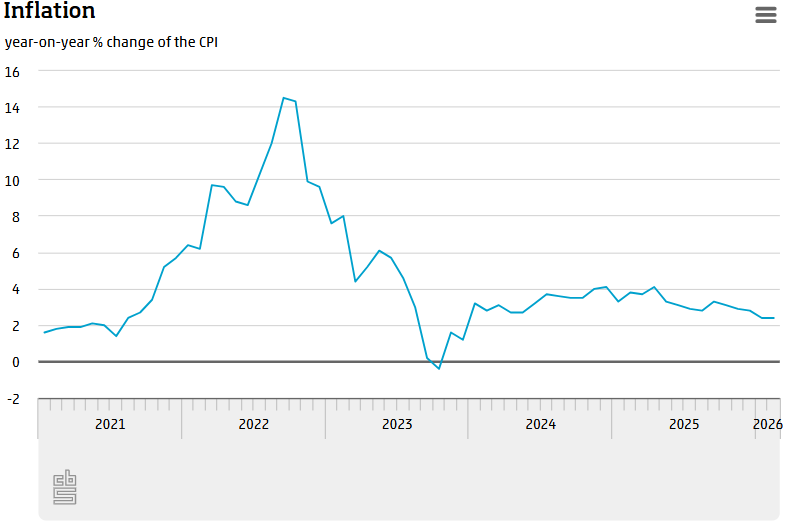
Detailed analysis shows varied pace of price growth in individual product categories. The highest price jump was recorded in services, which amounted to 4.2 percent year-on-year, while for food and beverage prices we’re talking about an increase of 1.4 percent. Particularly interesting are energy prices, including motor fuels. Compared to the previous year, they hardly changed at all, which is a huge difference considering the increases observed at the peak of the energy crisis.
IInflation stabilization is hugely important for the labor market, especially for sectors such as retail or hospitality. It is in these sectors that wages constitute a significant share of operating costs, and employers over recent years have had to raise salaries to keep up with rising living costs and maintain competitiveness in the fight for workers.
Retail Trade Gains – Rising Demand for Personnel
Turnover in Dutch retail trade increased by 2.2 percent in January 2026 compared to January of the previous year, with sales volume, adjusted for price changes, increasing by 1.2 percent. This growth, although moderate, shows that consumers in the Netherlands maintain a certain level of confidence in the economy and are willing to spend money despite earlier turbulence related to high inflation.
It’s worth noting that the food sector recorded a turnover increase of 2.6 percent, but supermarkets did better than specialist stores. Large chains increased their turnover by 3.2 percent, while smaller stores recorded a decline of 0.9 percent. This situation shows that consumers are still looking for savings, and due to economies of scale, prices in large-format stores are significantly lower.
In the non-food sector, sales at the level of 1.9 percent were recorded. The biggest increase was recorded by consumer electronics stores, as their turnover increased by as much as 10.8 percent. Good results were also recorded by personal care product stores (+8.9 percent) and footwear stores (+4.1 percent). Importantly, the fastest-growing segment of Dutch retail trade, namely online trade, also continued its upward trajectory. It increased its turnover by 3.6 percent in January 2026, with online sales of food and personal care products growing particularly dynamically, by as much as 7.0 percent.
How should the labor market read this data? It means growing demand not only for workers in traditional brick-and-mortar stores, where salespeople, cashiers and shift managers are needed, but also for staff in logistics centers and warehouses serving online trade, where manual workers are involved in order picking, product packaging and logistics system operation.
HoReCa Industry: Turnover Growth, Business Pessimism
The Dutch hospitality and hotel industry can also be pleased with growth. In its case, turnover increased by 3.2 percent compared to the same period last year. However, it should be noted that this result is the result of differentiated trends in individual segments of the industry.
Catering services did significantly better than the accommodation sector, recording a turnover increase of 4.2 percent, while in the case of the accommodation sector, this increase was only 0.5 percent. The highest growth in the catering segment was recorded by catering services and canteens (6.2 percent), which shows that both private companies and public institutions have returned to regular use of external catering services after the period of restrictions related to the pandemic.
Fast food restaurants increased turnover by 4.7 percent, traditional restaurants recorded growth of 3.7 percent, and cafes and bars recorded growth of 2.6 percent (source). The accommodation sector presents a more complex picture, where the increase in hotel turnover by 2.3 percent was almost completely offset by a decline of 4.2 percent in the holiday rental and camping segment.
Despite the increases shown above, sentiment in the hospitality and hotel industry is not optimistic. This is shown by the business confidence indicator in the sector, which fell from minus 8.4 at the beginning of the fourth quarter of 2025 to minus 12.0 in the first quarter of 2026. This pessimism of entrepreneurs is primarily due to negative expectations regarding economic prospects for the next three months and growing concerns about the availability of qualified staff and rising costs, especially in terms of wages.
Staffing Challenges of the Dutch Labor Market
Turnover growth in retail trade and the HoReCa industry directly affects greater demand for workers. Taking into account the current state of the Dutch labor market, entrepreneurs are aware that this will be a huge challenge for them.
The Netherlands has been struggling with a structural shortage of labor for many years. This is influenced by many factors, including: demographics, low unemployment, low birth rate, high employment rate of people of working age and much more. This means that the pool of available workers is small and continues to shrink.
Industries definitely more exposed to staffing problems include retail trade and the HoReCa industry. This is due to the fact that these industries offer relatively worse remuneration compared to other sectors of the economy and require work at unpopular hours, including evenings, weekends and holidays. One should also remember the very high turnover among employees.
In times of low unemployment and a competitive labor market, it is increasingly difficult to find candidates willing to work in positions such as waiters, cooks, cashiers or warehouse workers. The solution to the problem of labor shortage may be obtaining workers from other countries such as Poland, Romania or other countries of Central and Eastern Europe. People from these countries have for years been an important part of the workforce in Dutch hospitality and trade, contributing to maintaining the operational continuity of companies.
How Intraservis Supports Dutch Employers
In response to the growing staffing challenges of the Dutch labor market, Intraservis offers comprehensive solutions for employers in the retail, hospitality and hotel, logistics and other sectors. As a specialized employment agency operating in both Poland and the Netherlands, Intraservis understands the specifics of both markets and can effectively connect the needs of Dutch employers with the aspirations and competencies of workers from Central and Eastern Europe, who are looking for attractive employment opportunities in the stable legal and economic environment that is the Netherlands.
Intraservis services include a full range of support, from defining the employer’s staffing needs, through recruitment and selection of suitable candidates, to support in the relocation process, administrative formalities and integration of employees in the new workplace. For Dutch employers, this means the possibility of quick and effective filling of vacancies without having to invest time and resources in building their own recruitment channels abroad, and Intraservis ensures that the workers provided have appropriate qualifications, are motivated to work in the Netherlands and receive the necessary support in terms of accommodation and adaptation to life in a new country, which significantly increases the probability of long-term employment and reduces turnover.
For workers from Poland and other countries, cooperation with Intraservis means access to legal employment in the Netherlands, competitive pay conditions in line with Dutch standards, support in finding housing and assistance in completing all formalities related to registration, insurance and opening a bank account.
Intraservis services become particularly important for employers who see growing demand for their products and services. Business owners need certainty that they will be able to secure an adequate number of workers to serve customers, prepare meals, manage warehouses and fulfill orders. Thanks to cooperation with Intraservis, they have the opportunity to scale employment in response to changing business needs, without the risk associated with lack of staff at key moments of the year, such as the summer season in tourism or the pre-Christmas period in retail. At the same time, they have a guarantee that all legal and administrative aspects related to the employment of foreign workers are professionally managed in accordance with the applicable provisions of Dutch labor law.
Summary
The Dutch consumer market in 2026 shows signs of stable growth, with inflation staying at a controlled level of 2.4 percent, retail turnover growing by 2.2 percent and the HoReCa industry increasing revenues by 3.2 percent in the fourth quarter of 2025. These are very positive economic indicators that show that the Dutch consumer still trusts economic stability and is willing to spend money. This in turn creates development opportunities for entrepreneurs.
It is worth remembering that this growth also means new staffing challenges that business owners must deal with. The shortage of workers in the Dutch labor market is becoming increasingly acute for employers in hospitality, hotels and retail. This is a real problem, and it is deepened by concerns about rising operating costs, which can lead to blocking enterprise development.
In this context, cooperation with specialized employment agencies, such as Intraservis, becomes a key element of human resource management strategy for Dutch employers. Thanks to the possibility of quick and effective acquisition of qualified workers from abroad, while ensuring comprehensive support in terms of relocation, integration and handling of administrative formalities, companies can fully exploit market growth potential and build competitive advantage in times of structural labor shortage.
FAQ – Frequently Asked Questions
What is the current inflation rate in the Netherlands?
According to CBS data, inflation was 2.4 percent in February 2026. This is a significant improvement compared to the peak of 14.5 percent in September 2022. Inflation stabilization means greater predictability for employers in planning wage budgets.
Which retail sectors are growing the fastest?
Consumer electronics trade is growing the fastest (increase of 10.8 percent) as well as personal care products (8.9 percent). Online trade increased turnover by 3.6 percent, with online food sales increasing by 7.0 percent.
Why are HoReCa entrepreneurs pessimistic despite turnover growth?
The business confidence indicator fell from minus 8.4 to minus 12.0, despite a 3.2 percent increase in turnover. Entrepreneurs fear a slowdown in demand, rising wage costs and difficulties in recruiting workers.
What are the biggest staffing challenges for Dutch employers?
The main problem is a structural shortage of labor resulting from an aging society and low birth rate. The HoReCa industry and retail trade suffer particularly from low wages, unpopular working hours and high turnover.
How can Intraservis help Dutch employers?
Intraservis offers comprehensive recruitment of workers from Poland and other Central and Eastern European countries, support in relocation and administrative formalities and assistance in integration. Employers can quickly fill vacancies, and workers receive support in accommodation and adaptation.
Do foreign workers receive the same wages as local workers?
Yes, all workers employed by Intraservis receive remuneration in accordance with Dutch legal and industry standards, complying with minimum wage rates and conditions specified in collective labor agreements.